

Single Vision vs Progressive Lenses Which Is Right: Bangladesh Guide 2026


Single vision vs progressive lenses which is right for you? This is one of the most common questions we hear at OpticoBD. Choosing the right lenses for your eyeglasses can feel overwhelming, especially when you’re standing at the counter wondering what the difference really is between all those options. Many people don’t realize that the type of lens you choose affects not just how clearly you see, but also how comfortable you feel throughout your day. Let’s break down two of the most common lens types — single vision and progressive lenses — so you can understand which one truly fits your needs.
Understanding Single Vision Lenses
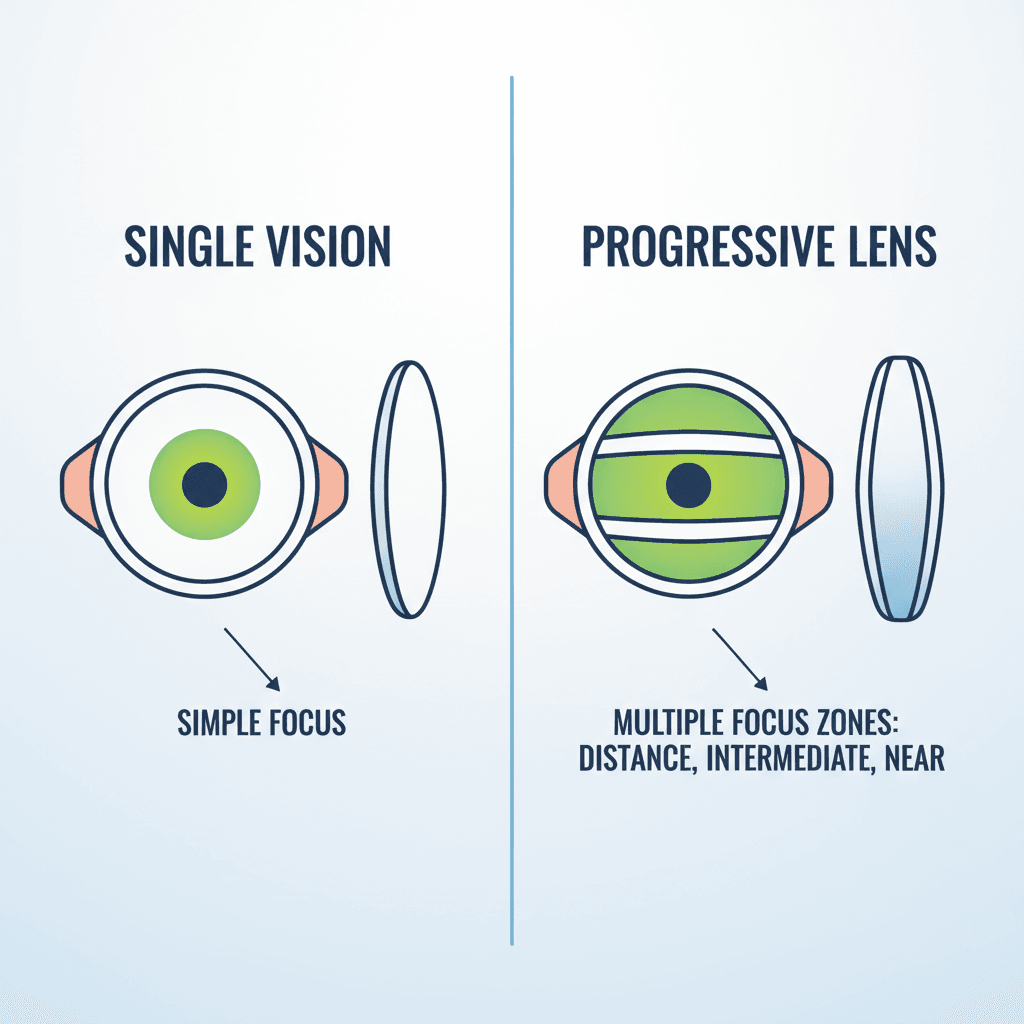
Single vision lenses are the most straightforward type of corrective lens. They’re designed to help you see clearly at one specific distance — either far away, up close, or at arm’s length. If you’re nearsighted and struggle to read street signs while driving, or farsighted and need help reading books, single vision lenses focus on solving that one particular issue.
These lenses are popular among younger adults, students, and anyone whose vision needs haven’t become more complex yet. The clarity they provide is excellent because the entire lens surface is dedicated to one purpose. There’s no adjustment period, no learning curve — you put them on, and everything just looks sharper.
Another advantage is affordability. Single vision lenses are generally less expensive than multi-focal options, making them a practical choice for first-time glasses wearers or anyone working with a budget.
What Makes Progressive Lenses Different
Progressive lenses take a different approach. Instead of correcting vision at just one distance, they seamlessly blend multiple prescriptions into a single lens. The top portion helps you see things far away, the middle section handles intermediate distances like your computer screen, and the bottom area is optimized for reading or close-up work.
What makes progressives special is that there are no visible lines dividing these zones. Unlike older bifocal or trifocal lenses that had obvious segments, progressive lenses look exactly like regular glasses from the outside.
Progressive lenses become particularly useful around age 40, when many people start experiencing presbyopia — a natural condition where the eye’s lens loses flexibility, making it harder to focus on nearby objects.
Decision Guide: Which Lens Should You Choose?
| Your Situation | Recommended Lens | Why? |
|---|---|---|
| Under 40, only need distance OR reading help | Single Vision | Simple, affordable, no adaptation needed |
| Over 40, need both distance AND reading help | Progressive | One pair does everything, no visible lines |
| Office worker, multiple screens + documents | Progressive | Seamless transition between distances |
| Student, mostly reading or computer work | Single Vision | Clear, sharp vision for one distance |
| Driver, need distance + dashboard + GPS | Progressive | Distance + intermediate in one lens |
| First-time glasses wearer | Single Vision | Easy to adapt, budget-friendly |
| Already have separate reading glasses | Progressive | Replace multiple pairs with one |
| Active lifestyle, sports | Single Vision | Wider field of view, no distortion |
Frequently Asked Questions (FAQ)
What is the main difference between single vision and progressive lenses?
How long does it take to adjust to progressive lenses?
Can I use progressive lenses for computer work?
Are progressive lenses worth the extra cost?
What is the price of single vision vs progressive lenses in Bangladesh?
Do progressive lenses work for night driving?
Making the Right Decision for Your Eyes
Both single vision and progressive lenses have earned their place in modern eyewear — neither is better or worse in absolute terms. The question isn’t about following trends or choosing what sounds more advanced. It’s about honestly assessing how you use your eyes every day and what would make your life easier.
Single vision lenses offer simplicity, affordability, and immediate comfort. Progressive lenses provide versatility and eliminate the hassle of carrying multiple pairs of glasses. Your age, prescription, work environment, and personal preferences all play a role in making this decision.
At OptiCoBD, we believe that great vision starts with great understanding. Explore our eyewear collection and see the difference clarity makes. Learn more: সিঙ্গেল ভিশন বনাম প্রগ্রেসিভ লেন্স | AAO: Progressive Lenses Guide